Showing posts with label dnd. Show all posts

Saturday, November 12, 2011

My City: A D&D thought experiment

I just sent the following in an email to my players, in preparation for whatever I will be running as a game in the new year. Once I have gotten the results and melded them into a city design, I will post it for you and for them.

I want you to think of a city - from the perspective of a D&D character. This doesn't necessarily have to be a character you end up playing, but this should be thought of in a worm's eye perspective, rather than that of a designer.

You may be from the city, you may have traveled here from a long way away, you may be just passing through. Make decisions about these things as you answer them. There is no minimum or maximum to the detail you provide, but remember that I am not asking you to create an entire city, just a city as your character sees it. Don't worry about the overall world setting, it can be anything you imagine as a fantasy world. You are not responsible for designing the entire world, just answer the questions as they are asked.

I will be using your responses to craft the city and world. With five of you providing possibly contradictory responses, please understand that not everything will be used in the full context you provide.

1) If you traveled to the city, how did you get here - what means of transportation? If you were born in the city, how do you get around?

2) What is your favorite part of the city? What is your connection to this place?

3) What is the most dangerous part of the city? Have you ever been there?

4) If you got into trouble in the city, who would you ask for help?

5) If you could remove one group of people or things from the city, it would be the...

Have you done anything similar for your game? Are there any other questions you think I should have asked?

Tuesday, November 8, 2011

Failed Experiment


As I am preparing to run a new D&D game soon, I thought it would be good to stretch the old design muscles a bit. Maybe get some feedback that doesn't involve players whining as their character is slowly digested. You know, like they do...

This adventure, titled Failed Experiment (not to be confused with expirement, which is failed spelling), is an adventure which touches on multiple arcs of my Doorways campaign, and as such I can't give a lot of details on the backstory. Descriptions will be based on what the players encountered.

If this adventure is used outside of the context of Doorways, one clue needs to be provided to the players ahead of time, or the encounter in 3 should become something less dangerous. During the orientation, the new explorers are told of a password "fealty" which was found to control the clay golems that were guarding the Doorways when they were discovered. Since that time the password has been changed to keep them under administrator control, but if a clay golem is encountered while exploring, that password should be tried.

1 The entryway - this room is tiled with five foot stone slabs (conveniently enough for mapmaking) with various geometric shapes. The slabs marked with a spiral symbol may be safely stepped upon. Magically levitating or flying over an unsafe square will still trigger a trap effect. Non-magical flight will not trigger a trap, or any weight under 30 lbs.

Description "This room, roughly 40' by 85' in size, is illuminated brightly by glowing patterns on the five-foot square slabs which make up the floor. The ceiling is 10' tall and dotted with neatly spaced circular holes, so that 2-3 holes are above every square. Similar holes are present on the walls all around this room, and each slab (except the first one immediately in front of the door, which is unmarked) has a circular hole in the center. A llitter of bones and fragments of grey-black eggshell is scattered about the floor in this room."

Any time a weight of 30' or more is set upon a square (or something of that mass is levitated over one) roll a d10 and consult this chart – if they step on a safe square, roll anyways and ignore the result. All traps are spell-based, assume a caster level of 8, and a relevant attribute of 18.

1 nothing happens

2 burning hands is cast from the floor – 5d4 damage to anyone in the triggering square, and to anything flying or levitating in an adjacent square. Reflex dc 15/half

3. Magic missile is cast from the west wall targeting the first person or object to trigger this square. 4d4+4 from the four magic missiles.

4 nothing happens

5 stinking cloud is emitted from the floor. Effects as per http://www.dandwiki.com/wiki/SRD:Stinking_Cloud 20’ radius, fortitude dc 17 negates, 8 round duration

6 web spell is cast from the ceiling above the triggered plate, http://www.dandwiki.com/wiki/SRD:Web 20’ radius, reflex dc 16

7 darkness is cast from the east wall, caster level 8, targeted on the triggered plate - http://www.dandwiki.com/wiki/SRD:Darkness

8 nothing happens

9 flaming sphere is cast from the west wall, every round for its 8 round duration it will simply bounce in this square. http://www.dandwiki.com/wiki/SRD:Flaming_Sphere – 2d6 damage per round for anyone in that square, reflex 16 negates.

10 lightning bolt is cast from the east wall, targeting in a straight horizontal line through the triggering square. The west wall absorbs the bolt rather than reflecting it. 8d6 electricity damage, reflex dc 17

The secret door on the west wall will not cast any trap spells, so ignore any results indicating a trap coming from that section of wall. It appears the same as the rest of the wall otherwise.(search dc 18)

2. Hallway

Description 'This hallway is neatly carved and smooth, apparently cut from the native stone and seamless. There is no dust, and the stone appears polished. Immediately beyond the door are two statues set into the left and right wall, each in the form of a grinning gargoyle, holding a stone shield and club, apparently carved from the same stone. The gargoyle on the left bears the spiral symbol on its shield, and the one on the right has a simple skull etched into the shield. '

The spiral and skull represent a warning, as between this point and the laboratory(5), any right turn leads to traps and other dangers.

The large X-in-rectangle represents a 30’ pit trap hidden by a hinged trapdoor(spot dc 23, search dc 18) which will drop with as little as 40 lbs of weight - the walls are as smooth as the rest of the dungeon, and are difficult to climb (climb dc 19) – in the bottom the adventurers will find a metal belt buckle, several dozen rivets from a suit of studded leather armor, and a +1 short sword of spell-storing (contains web, cl 10) – none of these show any sign of corrosion.

The stick figure icon in the top-right corner of the map is a clay golem – if not pacified with the command word “fealty” it will attempt to grapple a party member and take them for holding in room 3. If it suffers 25% of its hit points in damage, it will begin fighting more violently. Remember that while in the 5’ passageways it will take penalties to movement and combat for being squeezed http://www.dandwiki.com/wiki/SRD:Movement,_Position,_and_Distance#Squeezing

2a The false door

Description 'As the hallway turns it becomes a more stately 10' corridor, with a double-door at the end, cunningly crafted from the same native stone.'

Starting at the door and for 15 feet, the corridor has an acid pit concealed by a trap door which opens downward. The weight of one medium creature (and his gear) will not trigger the trap, but two or more party members on the trap door will cause it to open, letting them fall in.

The trap may be escaped with a dc 18 reflex save for those on the north and south edge (moving to safety or clinging to the false door), and a dc 22 reflex save for anyone caught in the middle. A swim check (dc 15) is necessary to move in the acidic slime, and climbing out at the north edge is a climb difficulty of 15. Climbing up in the middle or door side is a dc of 19, with another climb check dc 15 required to slide along the wall to safety in the next round.

Anyone immersed in the acid will suffer 2d6 damage per round, and those who have been immersed will suffer an additional d6 damage for 3 rounds thereafter as the acid neutralize it. Attempting to wash the slime off with water or otherwise neutralizing it will reduce the damage by 3 points and the duration by 1 round.

The double-door at the end of the hall is a cunningly crafted fake, (search dc 23 will reveal the trickery - the dwarven ability to detect stonework will also work). On any lesser search result, the door appears to be unlocked, but stuck shut.

3 The guard room

This room is bare and empty except for four clay golems – they are under orders to hold any intruders (they will attack if they suffer 25% or more of their hitpoints in damage) – They may be commanded with the same word “fealty”

Needless to say, the golems don’t have any way to meet the needs of a prisoner for food and water, so time will be limited if the party plans to return to rescue them.

4 The quarters

This room is bare but shows signs that there was once habitation here. Depressions are in set in the floor where the feet of two beds would have been, and several iron nails are scattered in the room, along with several gold teeth and a silver dagger. 43 gold and 25 silver coins are scattered about the floor, and the broken remains of a water basin. An everflowing flask of water is sitting in the corner, deactivated.

5 The pit

This rounded chamber, and the narrow passageways leading to it, are used the black puddings that inhabit this dungeon – the passages are appropriately sized for a small-sized or smaller creature, but the puddings can pass through slowly. While the puddings are drawn for reasons unknown to the laboratory in 6, they use the steep downward shaft leading down from this chamber when driven to feed – where it leads the team was not able to learn, but it is at least 50’ straight down.

6 The laboratory

This room, once used for research, has three entrances, two concealed entrances on the east wall (search dc 18) , and one of the pudding-tunnels behind a workbench.

There are three stone workbenches in this room, covered with the remains of broken beakers and glass tubing. If handled delicately, 3d4x10 gp worth of alchemical equipment can be recovered, and the optics for three pairs of goggles of minute seeing. A silver dagger has fallen behind one of the workbenches.

In any of the areas aside from 1, there is a 10% chance of encountering a black pudding – no more than 2 will be encountered in total unless the party spends 10 hours or more in this dungeon(a third will return from the depths). The clay golems will ignore the puddings and vice-versa, unless they are keeping a prisoner in which case they will defend him or her.

And that is the adventure – it has a bit of a killer DM feel to it, and I don’t intend to run it for my current party (especially after posting it here), without doing some fine-tuning.

If you’re asking “where is the treasure?” then you have not been paying attention – the clay golems are worth 40,000 gold each, if controlled – it is probably far more wealth than this dungeon should have generated for them. This is more of an exercise, stretching my design muscles. I will say that I don’t feel any of the challenges are unfair for a 3rd-7th level party – a black pudding is tough to beat, but can’t keep up with the party and can be dealt with at range. The golems can be used, if controlled, to defeat them as well.

If the party turns off their brains and play this like Diablo, things will go very badly. I think this represents the design philosophy I am planning on – fair but very tough.

Am I hitting that mark?

Friday, November 4, 2011

Applying the List Method

So in my earlier post on design, I mentioned how I would give a list of possible adventures with limited data on which to decide what to do next.

What about in town? When staying at a motel or hotel, in almost any town or city, a list is provided:

Restaurants

The Owlbear's Nest - Come sit by our hearth and listen to the finest in local bards, and choose from our unmatched selection of dwarven ales.

Beholder's Eye - Our master chef will levitate your meal directly to your plate, a dining experience you will never forget.


The Extended Rest Inn and Tavern - Proudly re-opened after extensive re-modeling. Please leave your pet dragons at home.

Little capsule descriptions of local businesses written to attract customers. This list does not have to be complete, but will include most that are on the beaten path.

Unlike the list of doors, these locations will have to be fleshed out a bit more in advance, but won't require the same list of details. Maybe a floor plan, a menu, and a list of four NPCs (shouldn't need combat stats of their own) to provide local flavor.

When the players are traveling to these locations, I don't plan to skip "ok you walk to xyz bar", at least the first time. Mentioning businesses, open and active or closed and boarded up can provide hooks for future adventures, establish these places in everyone's minds.


Thursday, November 3, 2011

My own personal edition wars

In preparing for a new game, I have to decide which system to run. It isn't an easy decision.

Pathfinder? In the next week I am expecting to receive a copy of the Pathfinder starter box, and I plan on picking up the core book if it is not under the tree this year. Am I going to run Pathfinder? Maybe. I have heard good things about it and it seems to address some of my concerns with three dot five.

Four-eee? I recently was confined to a small home in Ballard, given stimulants and piloted a Kenku Rogue for about 21 hours. Our DM, Mr. wh40d6 ran a fine game and I had a good time. I didn't feel as much frustration with the abstractions of fourth edition as I have in the past (I played once for about an hour and became extremely ill, but I can't prove that 4e was to blame).

This system has a lot of safety rails - the dungeon master has guidelines on how much xp an encounter should have, character classes have well-defined roles, players manage resources in the form of power cards which add a great dell of homogeneity to the game. A player only needs to learn one or two mechanics, like marking a foe, to play a new class or role. A wizard has a sharply limited list of combat powers and rituals, which is easier but feels limiting.

There are also some excellent simplifications. A monster has a level, and a set xp value, which makes dungeon stocking and xp allocation much quicker for the DM. Single-hitpoint minions provide a great source of dungeon fodder that is quicker and easier to run. Movement, much as it pains me to admit it, is a lot quicker and easier when you just say that diagonal moves are also 5 feet.

Aggregated skills - "perception" is spot, listen, and search rolled into one. This is great unless one is playing a rogue, as it is wisdom-based. More on this later... "Stealth" is hide and move silently together. "Thievery" covers removing or setting traps, and pickpocketing. Similar reductions are made in social skills as well, I am told.

4e also turns saving throws into resistances, so the attacker rolls against fort rather than the defender making a saving throw. Interesting, but I could take or leave it. It is, I suppose, more consistent.

In short, many little changes that make the game easier (but more limiting) to play, and remove DMing headaches. I can't bring myself to embrace 4e. I will happily play it in the future, but just not ready to call it my game. Maybe I'll like what Monte is Cook-ing better.

Retro-gaming/OSR I should have a card printed up saying "I believe that newer does not necessarily mean better, and embrace the themes of classical gaming." just so i can claim to be a card-carrying grognard.

That being said, I don't like old-school saving throws and descending Armor Class. They are more work than they are worth to keep track of. I do like simple character sheets and large, forbidding dungeons.

The "old school" scene is alive and kicking, but my players just aren't excited about it. Sites like jrients, bxblackrazor and grognardia are good jumping off points if you are curious.

Three-dot-five Third edition, so they told us, was the most researched and playtested system ever. Until they came out with 3.5 to fix all the broken stuff.

I like 3.5, I really do. I have run or played more of this edition than any other version of D&D. It is a comfortable, well-worn suit, but it also has some annoying holes that I keep meaning to patch.

I. Lots of source material, which different abilities and options for players who want to really give the DM a headache. Even the official material is pretty questionable at times. However plugging this hole is tough. Despite the headaches of the material that is unbalanced, there are plenty of fun, well-balanced classes, feats, and spells.

II. Complicated experience. In order to figure out how much a combat is worth to the party, one must take the number of enemies defeated, and their CRs, and consult a table in the DMG, to determine what the overall CR of the encounter was. If two monsters are in a fight and they have different CRs, the rules are a little murky, but it is touched upon. Then, after finding the CR of the encounter, the DM must find the CR on a table (cross-referenced by party average level) and divide the experience points by number of players. I got pretty fast with this, but it really makes the static XP in Pathfinder/4e look appealing.

I had actually made this part tougher on myself by figuring experience separately for each character based on their level (the theory being a 2nd level character would learn more from an encounter than a 5th level one). This is probably a bit wrong-headed as the points needed to level up grow at each level, and I never had player characters more than a level different from one another. It suited my desires for granularity and fairness.

III. Movement - In 3.5, most characters move 30' per round, which is 6 squares. Feels limiting, but it works pretty well. But what about diagonal movement? Let's see.. 5^2 +5^2 is.. 50, and the square root of 50 is 7.0710678118655 or so.. Yeah lets go with 7.5, which means every other square moved diagonally is 15, which doesn't leave you with a decimal after moving 28.28 feet.

This approach appeals to my math geekery, but even a simple count-off like 7.5, 15, 22.5, 30 will trip me up in the heat of battle. 4e makes it 5 foot movement, which is more than a little broken (whee, by moving this way I can move fifty feet per round!) but it really makes things go quicker. For the sake of an easier quicker resolution of movement I sacrifice logic and physics, and after running a long 3.5 campaign .. 30, uhh.. 37.5, 45, 50... 2 point 5.... Yeah I think it is a price I can pay.

IV. Boring critical hits.. Well perhaps I won't fix this, but I keep wanting criticals to do more than double damage. Not triple damage, but stuff. Limbs shattered, heads removed, weapons and armor destroyed, the carnage of a fantasy battle.

The problem is that players will inevitably, and rightly feel screwed by this. Player characters are almost always outnumbered by enemies, so the DM has many more chances to roll those devastating criticals. And a player character has to live with the consequences. That owlbear you removed two limbs from probably won't be coming back for revenge, but the DM can just pull two more from the nether for the next battle. Monsters and npcs generally don't survive battles, so never walking again simply doesn't matter.

V. Battle management - Stealing minions from 4e sounds like a good idea, but 3.5 doesn't work the same. There are Area of Effect spells that deal so much damage that even a successful save should kill them. If I use them, I plan on having a "threshold" hp level -do this much damage and the minion simply doesn't get a saving throw. Also I can't easily use minions with "damage sponge" monsters like gargoyles, so I may likely limit their use to battle fodder, orcs who keep the party busy while the bigger bads ready the nukes.

VI. Too many skills – see what I said about 4e above aggregating skills. If I do this I will be strongly tempted to let characters (like rogues) with Trapfinding use intelligence for perception rolls instead of wisdom. It isn’t a huge bonus at higher levels, but it remove the fear of straying from the party that I felt as a 4e rogue.

What will I run? Not sure yet. The nice folks at paizo have released an SRD that allows me to read through most of their rules-set, so I will be spending time poking through that. I plan to go through the various 3.5 sourcebooks and see what, if anything, I feel strongly enough to ban from my game. The “spell compendium”, as it contains a large amount of suspect fan-created material from Dragon magazine, is unlikely to make the cut. I may go into that book in more detail in a future post.

What do you run?

Wednesday, November 2, 2011

Getting my design on...

It has not been decided what system I will run, who will play, or what the campaign will specifically be, but in the new year, there will be Game.

And I am even planning to run it.

I had been putting serious thought into a campaign based on the consequences of adding guns to d&d. Inspired by images like this:


I saw adventurers cutting a path to adventure with both powder and magic of the black variety. Maybe it would be a sandbox game, maybe it would be a game of intrigue and warfare.

In the wilderness one might encounter groups of elite blue-cloaked riflemen, pursuing the elven rebels of the silver skein, a band fighting for freedom or revenge against the brutal and systematic oppression of their kind. I saw adventurers coming into contact with these factions, taking a side, or trying to broker a peace.

It would be powerful, and dramatic, and grim, and bloody, and.. Started to sound like it wouldn't be any fun. I think the story has potential, but as the backdrop of a campaign had the risk of being a series of downers, including a plan I was working up of having a wilderness community that the players would use as a base of operations, forming bonds with the NPCs, becoming involved in their lives, only to find they had been pointlessly slaughtered by one faction for trading with the other. I just didn't want to run it. Maybe in the future I might use it as source material, but I just don't want it now.

So instead I am thinking of something like Stargate meets D&D, but with the players as prospectors rather than soldiers (so more like Fred Pohl's Gateway novels). A hallway of many doors, leading to many adventures. If a player is missing one week then he doesn't step through the door. It could work.

The heart of how I will run this (if I don't decide to do something else) will be similar to Westmarches. The players will have a list of doors, and the initial scouting mission resuts, and they tell me in advance of the game where they will be exploring. I don't know that this will be a 1-20 campaign, but I can run it for as long as it maintains the fun.

The initial scouting mission is a clay golem carrying a cageful of rats. It is instructed to enter the door, stand still and observe for five minutes, then return through the door. If attacked, it should return immediately. Adventurers wishing to explore these various doors are given the information gleaned from this to decide on which doors to try, and prepare as much as possible. The adventurers are considered expendable, no rescue attempt is sent if they do not return.

B@ R@ Golem returned unharmed, saw worked-stone underground passageway - the rats were all asphyxiated. The scouting mission that followed did not return (they carried a bottle of air)

G@ R@ Apparently dwarven construction, golem returned without incident. No exploration yet.

B@ R@ Golem did not return, one enormous mutated rat came back through door an hour later. No exploration yet

B@ R@ Golem saw nothing (apparently magical darkness) rats returned drained of life by negative energy. No exploration yet.

[blogger is stripping the colors out that I am setting. G next to the @ is green, R is red, B is black]

The first @ indicates the result of the golem's exploration, the second @ any human exploration.

When nothing returns, the door is coded double-black and exploration is forbidden.

Not all the doors will be considered level-appropriate for the players - no idea yet how they will react to this concept.

I may post a sample-dungeon based on one of my hooks, to show how it relates to the exploration mission. Things should be hard, but not unfair.


Tuesday, November 1, 2011

How about another stab at mobile blogging?


Posting on blogspot on my phone seems to work, if I use the right browser, and for a few hundred words. After that the scripting on the page uses up too much memory and my phone closes the browser to resolve the issue, taking my work with it.

So now I am writing this out using Word Mobile, in the hopes that it won't cause me to lose a large draft along with 1d6 san. I can hope, right?

There has not been another Fishy the Ranger session since my last post on the subject. After losing all his money and equipment, another assault on the Caves of Chaos would be suicidal, so I have another plan for the next session. We'll see how it turns out.


My friend and 21-hour dm mr wh40d6.blogspot.com was kind enough to loan me his copy of the D&D boardgame Castle Ravenloft, and I have played a couple games of this with my son - on the second mission we re-picked characters and powers. He went with the Dragonborn fighter (from the Ashardalon game) and I went with the Eladrin wuss, I mean wizard.

It turns out that his plan of taking a character with the highest available AC and HP was sound, I barely got through the final fight alive, and he was ready to bash several more monsters if they had shown up.

I won't try to give a review of these boardgames, firstly because there are a glut of such reviews already online, and secondly because I haven't played very much yet. I will say that I like it, and the 4e system of power cards works well in the context of a boardgame. The suggested age for the game is 12+, but there is nothing excessively graphic or scary in the descriptions, and the complication of the rules means that someone should be old enough to grok the rules, but not everyone has to.

Not sure what the word-count is now, but I am going to wrap this up here. If I can tap out a post or two while I'm on the bus, it becomes far more likely that there will actually be new posts in this space.

Sunday, August 28, 2011

Dungeons & Allies (Fishy the Ranger, Session 3)

Been a bit of a lazy sunday. Got up early with the baby but aside from time with her I didn't really do a lot of home-making today.

In the early afternoon my wife and daughter took a nap, leaving my son and I free to do some gaming.

First we tried out Axis and Allies Miniatures, which I picked up cheap in the "pick our bones clean" sale at Borders. Pretty fun, a bit of complication in learning the combat and movement rules. Beat my son with a point-inferior army (two units of which were pretty useless against his tanks) of a machine-gunner, a mauser, and a panzerfaust, and a panzer 3 (a 13 point tank, undergunned against his russian t34 and his sherman tank, 28 and 24 points)

So with such a deficient force how did I win? Cover and line-of-sight. Made a lot of "cover" rolls to avoid damage, and the panzerfaust's mysteriously unending supply of rockets won the day.

After a couple games, he asked whether Fishy could win versus a panzerfaust. I offered to make the german soldier as a D&D character and equip him out of the modern book, but he preferred to look at the meager attack numbers from A&A, pointing out that the panzerfaust could not hope to defeat his armor class with attack rolls that didn't go above four or five most times, especially as much as the d6s seemed to be hating my attack rolls in the last game. I mean really, if you throw ten six-siders, should not more than two of them give a result of more than three??

We only ran about an hour of D&D after this. Fishy effected an escape which is amazing, in that I am amazed I didn't have to fudge any rolls for him to escape with skin intact.

Fishy awoke on top of a table in the "banquet hall" (room 9 in your classic KoTB if you're curious and have that available) bound hand and feet, with two lazy guards in the room.

The winning strategy for escaping orcs, if you are curious, goes something like this.

1) Address the orcish guards in a random language, such as draconic or halfling.
2) Receive several beatings as you repeat step one, until you are reduced to a fraction of your original hitpoints.
3) Note that the guard, while he was smashing your face in with the non-business end of his sword, has accidentally dropped a small knife on the table next to you.
4) Having freed yourself, address the orc again, requesting he return your equipment. Fortunately the second guard has left temporarily to relieve himself (Legitimately he waited and watched for a moment after cutting his bonds with the knife)
5) Dispatch the orc with the knife, charge into an adjacent room carrying his sword.
6) After a couple rounds of combat with some orcish tribesmen and the other guard, flee through the banquet hall to exit B.

After it became clear the orcish guards were not going to go looking for them in the daylight, Fishy made his way back to the Keep, and tried to hire a patrol he encountered using the money that he didn't have.

Fortunately, his companion Jerin had been released after the first encounter, on his word he would return with ransom money for Fishy. Even more fortunately, Fishy did not go with his original plan after escaping of marching into the orcish cave with his two remaining HP and a small knife, demanding they return his equipment.


Wednesday, August 17, 2011

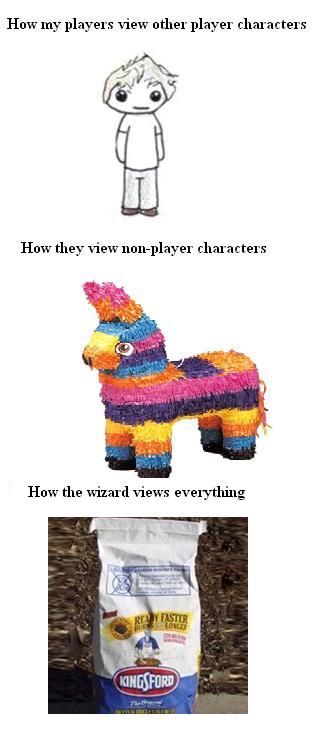
How Players View ....


Just a couple meme images I made.


Friday, July 9, 2010

The OSR Kool-Aid

is delicious, thank you! I'm not sure I qualify on either of Mr. Raggi's points yet, though.

I seem to be severely delinquent in my updating. Should try to correct this tonight. Maybe.

Played my first ever game of 4e last friday, playing my second one tomorrow. Still trying to form opinions which feel original. So far it seems to be confirming most of the positive and negative comments I have heard. Fun, gamish-over-simulationist, disassociated..

Trying to give it a fair shot.

Saturday, June 19, 2010

Critical thinking

I've never played rolemaster, but I understand it to be something like this..


One of the useful, but somewhat dull and mechanical features of 3.x is the critical hit system. Criticals deal double damage, or more depending on the weapon. Some feats improve this, and some feats improve how often the crits are done. My players are usually fairly excited to roll a crit, except for my crit-stacking munchkin Epik, but the issues which lead to my asking him to alter his character mid-session are for another time.

When I was in high school, I always did critical hits off the cuff -- if a twenty was rolled, then the die was rolled again, with escalating awesomeness depending on what was rolled from there. A second twenty would result in instant death, but I don't remember this ever happening. Triple or quadruple damage once or twice, however.

Now, as a grumpy thirty-two year old DM, I have been finding myself thinking about a return to older styles of play, including a more fluid system of critical hits, and critical fumbles.

In case anyone reading this is confused as to what I'm talking about, in the game of Dungeons and Dragons, attacking involves rolling a twenty-sided die, trying to roll at or above a target number. In most versions of the game, rolling a twenty would result in a more damaging hit, and rolling a one indicated some sort of failure.

I want to get away from the simple "this weapon does double, this one does triple" of 3.x, and have more solid, consistent results than if I tried to keep it in my head. This means a table. Something simple that operates on a d20, something with results from "oh cool" to "OMFG".

For critical success/critical hits, it seems the second roll for severity should be ascending, so 1 is minimal improvement, and 20 is maximum results. For critical failure/fumbles, it seems logical to have descending severity, but I am thinking that it should also be ascending. I have been thinking about the process of writing up some special abilities/special rules respecting the critical tables, and the rules will be simpler to write if both are ascending. So if you roll a 1, you roll on the critical fumble table, and hope you don't roll a 20. Somehow that seems inelegant to me, but anything that saves an extra 10-15 words I have to squeeze onto a notecard has to be a good thing.

So what kind of results do we want?

I would rather not have an "instant kill" option, but I can't take it completely out of consideration. A high result could cause a foe to be dazed for a round or two, possibly making a coup-de-grace an option.

Something that I'd like to have as a midrange option, in addition to a damage multiplier, would be nervous system shock -- being unable to see or hear for a round makes one an easier target, and lowers one's own attack roll. I don't like having perma-blindness as a possibility, or limb severing. Temporary limb disability would be fair to implement, I think.

I could fill out a table with those three, I think, combined with increasing damage multipliers.

So what about fumbles? Traditional results include weapon dropped, weapon broken, hit teammate, and lost turns. Hitting one's teammate, or "random selection of target within 10'", would probably be at the top of the list. Weapon drop would be at the bottom.

Weapon break is likely to be the most controversial at the gaming table. Players are, unsurprisingly, very attached to their magical equipment. Elendil might have broken Narsil, but that was in a cutscene. Bilbo or Frodo breaking sting on a bad roll would have just seemed unfair. I have a way to get around this, however.

I am planning on ruling that only one component of a magic weapon is enchanted. Everything else is conventional, and required to be of high quality and maintained to keep it in working order. With a sword, the grip could be non-magical, and could be compromised. The wooden stock of a crossbow or rifle, or the bowstave of a longbow would be magical. The magic part won't be broken, but the other components might be. Perhaps a magic sword without it's grip would cut viciously into the wielder's hand. The amount of repair work required to restore function is something that should probably be something that requires ten minutes to an hour of work for a person with appropriate weapon proficiency (as they are able to maintain their weapon)

"Lose a turn" sounds good from a gamist perspective, but should definitely be described creatively, something like the player slapping themselves with the flat of the blade, or stinging their fingers when losing grip on the bowstring. The players should be encouraged, as with much of the critical table, to declare the way in which their character failed. Pratfalls can be memorable, as much as gallant victories.

Dropped weapon would be move-equivalent to recover from, in general, but might not be possible if engaged in melee. Perhaps dropped weapon should be made more interesting, like the weapon is not just dropped, but flung d6*5 feet in some random direction. This kind of mechanic makes a backup weapon important to a well-prepared hero.

I have been considering, along with critical tables, including some luck mechanics -- maybe some special ability specific to thief-types, which allows a greater chance of getting a critical. Or the ability to occasionally add a d6 to the roll for severity of the critical success. I have been noodling over having a relative danger in adding the d6, where another d6 will be put on the table, waiting to be added to the next critical success or failure rolled by anyone.

That's it for now, just throwing out some thoughts.

Saturday, June 5, 2010

Muskets vs Longbows (Part 3 of 4, maybe)


Things aren't looking good for my 2nd edition musketmen.

I'm going to leave aside the theoretical soldiers for now. In 2nd edition the strength and dex scores don't have an impact below 16. I didn't give that score to any of my 3rd edition/D20 modern characters, so I on't dwell on it too much. With a bit of a nod to the concept of masterwork, bows with a cost of 3-5 times the book rate are mentioned to be able to deal extra damage as normal for the character's strength bonus.

The composite longbow, costing 100 gp, is listed with a Rate-of-Fire of 2/1, which means two arrows loosed every round, even for a level one fighter. The 500 gp arquebus, on the other hand, has an RoF of 1/3, one shot every three rounds. This jibes pretty well with the later versions, except that in the second edition of Advanced Dungeons & Dragons, a combat round lasts one minute. I'm told that a "player's option" book brought combat rounds down to 10-15 seconds with a "standard round" still taking one minute. No matter how long a round supposedly is, our bowman lets slip 6 arrows to one shot fired by an arquebusier. [As an aside, my spell-check doesn't like "arquebusier". I think it's correct, but it suggested a corrected spelling of Albuquerque.]

Damage is a complicated subject, with either weapon. The composite long bow, with a sheaf arrow, deals d8 damage with each strike. with range increments of 40, 80, and maximum bowshot of 170 yards. At medium range the attacker has a -2 penalty to their shot, and long range has a -5 penalty. With flight arrows, dealing only d6 damage, the numbers are 60, 120, and 210 yards maximum.

The arquebus has a comparable range, 50 yards medium, 150 yards long, and maximum range of 210. However, range penalties are doubled with that weapon, meaning that from 50 yards they will have a -4 penalty, and a difficult 150 yard shot carries a -10.

It's worth noting that the game of Advanced Dungeons & Dragons, most combat takes place underground, or in buildings, and those range increments are in yards, not feet. So multiply that 50 yards by 3, and divide by five, that means medium range doesn't start until 30 five-foot squares. Combats are generally smaller than that on my gaming table. Perhaps I could remedy that, but it's difficult using a grid map and miniatures 3.5 style to have bigger fights. So for personal level, rather than mass-combat engagements, I don't believe range is a significant factor here. I suspect the more modest ranges of weapons in 3.5 is because of this issue.

Anyways, the arquebus damage is weird. It's a d10 with an footnote: When a arquebus scores a hit, it normally does 1 to 9 points of damage on 1d10. When a 10 is rolled, the die is rolled again and this amount is added to 10. Each time a 10 is rolled, the die is rolled again and added to the previous total. Thus, in a rare instance, a single shot could inflict 37 points, for example, if three consecutive 10s were rolled, followed by a 7. The damage caused by an arquebus is never modified for a high Strength score.

The game also seeks to punish you for choosing this weapon, with a 10% chance of failure on each shot: If the attack roll for the arquebus is a 1 or 2, the weapon backfires, causing 1d6 points
of damage to the firer. It is also fouled and cannot be used again until it has been cleaned,
which takes about 30 minutes.

So, the arquebus.... Drastically slower to fire, possibility of doing a lot of damage with one hit, but just as likely to blow up in your face. The longbow can attack twice per round, with a modest damage output and no chance of blowing up in the user's face. The longbow has a longer accurate range, but most players won't encounter more than medium range in combat. Both have the same ease of use per the rules, which are a simple pass/fail of weapon proficiency.

I don't think I have any more sources available, unless I start looking at actual historical resources, like wikipedia. Let's do that next time, shall we?


Saturday, May 29, 2010

Muskets vs Longbows (Part 2 of several)

So last time I went into D&D, a game that is built specifically without guns (despite having many other examples of 16th century technology). The guns were too slow to fire (accurate), too expensive and required the same lengthy training as a bow, or even more so (inaccurate).

Well what about d20 modern, and it's d20 past splatbook? Surely in this version, longbows will be an inferior option.

As before, we'll examine four characters. Ephram and Faulkner are first level fast heroes, designed to be good at the use of their chosen weapons. Geoffrey and Harald are first level tough ordinaries, with no martial training at all.

Ephram, the musketman, can be built with a wheellock musket, or the more advanced brown bess musket. Both are muzzle loaders that require two full-round actions to reload, or one with the Rapid Reload feat (which Ephram has). His wheellock has a 40' range, and deals 2d8 (average of 9) damage. The brown bess has a range increment of only 20', but deals 2d10 (average 11) damage on a hit. It requires the Personal Firearms Proficiency feat, and Ephram used his last feat on Point-Blank Shot, for the usual +1 to hit and damage when firing at a target within 30'. Ephram only gets the benefit of his +2 dexterity bonus with the brown bess, the more primitive wheellock doesn't allow this for some reason.

Faulkner, the bowman, has the compound longbow from the d20 modern book. This is a bit of an anachronism, as this bow is made from modern materials and allows the character to use any amount of their strength bonus at no additional cost, which is different than D&D's composite bows, which are meant to represent the technology of the english longbow, a super-weapon of it's day. His compound bow can be fired every round, with no rapid-shot feat included in the D20 modern book as there would be in D&D. He can take advantage of his dexterity and strength bonuses, so his weapon is at a +2 to hit and deals 1d8+2 (average of 6.5/hit).

So this is an improvement over 3.5, for the musketman. 11 damage every other round is at least equivalent to 6.5 every round. However, the shots every round are going to hit more often than when they only get to fire every other round.

The shot every other round sounds slow, but remember that in either version, a combat round lasts 6 seconds. Here is a video of a competitive shooter putting out three shots in 46 seconds. That means this man would only have the personal firearms proficiency, and does not have the Rapid Reload feat. I don't think that seems correct.

The bowman firing once every six seconds, on the other hand, seems reasonable. This man is firing only a 20 lb bow, which is very easy to pull, but his 10 shots in 30 seconds means he's firing twice per round, which would jibe with the rapid shot feat in D&D, which isn't available to my D20 modern character. A D&D character at 10th level can be like the guy at the 2 minute mark of this video. 12 aimed shots in 17.5 seconds, call that 4 shots/round, which would be consistent with Manyshot and iterative attacks on a full-round action. (At 11th level he goes up to 5 shots per round). With primitive firearms there's no way to stack up that many shots because the reload time is too high.

The basic reason cited most often for why the gun supplanted the bow is training time. It takes a long time for a character to reach 3rd, or 6th, or 11th level, especially if this is through some sort of intensive training regimen, not the insanely rapid leveling that can take place with adventurers. Call it one year per level, and that means the bowman is getting steady increases in number of missiles he can fire, and a greatly cascading damage output. The musketman will only see a steady improvement in his chance to hit, every other round. If we treat the training time for a soldier as "time to reach first level", then a musketeer reaches his effective maximum in potential damage every round in one year, and from there only improves how often he succeeds. The bowman sees tangible improvements in damage output at almost every level, with the same increasing odds of hitting the target.

Let's pretend that last paragraph was in my previous post, ok? Rapid Shot and Manyshot aren't in d20 modern. So the bowman and musketman in this scenario, Ephram and Faulkner, both see similarly stagnant growth in damage output, with Ephram seeing an extra shot every five levels because of iterative attacks (second shot at -5, third shot at -10, etc), or would if this were a strong hero. Fast heroes have a slower BAB progression, but all the strong hero talents are completely worthless for a ranged character. I digress..

Geoffrey and Harald are tough ordinaries, farmers conscripted to fight. They have no stat bonuses or penalties, and no feats relevant to use of their weapons, a compound bow or musket, respectively. Geoffrey is able to fire once per round, at a -4 penalty to hit, and deals 4.5 damage per round if successful. Harald, lacking the Rapid Reload feat, fires once every three rounds, making his 9 or 11 average damage unimpressive to say the least. Conscripted bowman wins.

So in both of our examples, a trained soldier and a hapless conscript, the bow is superior in every respect to the muzzle-loading musket. The situation changes quite a bit if we bring breechloaders in, but this isn't about modern firearms, and the 18th century is definitely heading in that direction sharply from the muskets of the past.

Cost? Far from being a cheaply cast, mass-producable alternative to the bow, the wheellock musket is listed with a PDC of 23, which page 204 of my d20 modern book tells me is the equivalent of $5,000. The compound bow's PDC of 10 is only $120 dollars. The disparity is higher than is should be, as I'm taking the cost of the wheellock out of the d20 past book, which assumes it is a high-tech and somewhat exotic item for it's day, but the bow is in d20 modern, and it's a mass-produced sporting good. Modern firearms weigh in between $500 and $2,0000. I would personally adjust these numbers, but for now I'm only examining the rules-as-written. House rules will be coming later.

So in D&D and d20 modern/past, firearms are more expensive, require the same level of training for basic competency, and have an inferior damage output overall. How accurate are these? Next time I'll examine historical sources, like 2nd edition.

Tuesday, May 25, 2010

Muskets vs. Longbows (Part 1 of ??)

I've been thinking about firearms. And D&D. And firearms in D&D.

From the historical sources I've heard, early firearms were crap compared to the simple bow & arrow. Terrible rate of fire, poor (accurate) range, even lower muzzle velocity. The only thing that sets the gun apart from the bow in the beginning is cost and training time. high quality longbows were more expensive to make than early guns, which were cast cheaply from iron. Teaching a man to load and fire a gun took weeks. The longbow was a lifetime pursuit.

Anyways, let's look at a few example characters. Alfred, Bertram, Claude, and Derek.

Alfred and Bertram are first level fighters. built using the Elite array. This gives each of them a 15 dexterity, and 14 strength. They are both professional soldiers who have been trained for several years to reach this point.

Alfred has Point-Blank Shot, Rapid Shot, and Precise Shot as feats. He carries a composite longbow which cost 300 gp, which can take advantage of his +2 strength bonus.

Bertram has Exotic Weapons (Firearms), Point-blank Shot, and Precise Shot as feats. He carries a musket, described on page 145 of my 3.5 DMG as a cost of 500 gp.

Alfred's composite longbow has a range increment of 110 ft, Bertram's musket has a range of 150 ft, which is perhaps overly generous, but I am sticking to Rules-As-Written. In RAW, the musket deals a d12 in damage, for an average output of 6.5/shot. The composite longbow deals a d8+2, also dealing 6.5/shot. with a higher minimum of 3 damage, and a lower ceiling of 10. In general I think this is better against low-level enemies.

Alfred, using a longbow which is reloaded as a free action, can use rapid shot to fire twice in a round, with 10% less chance of hitting on either. I don't know how to crunch probabilities, but I assume that two shots at 40% is better than one shot at 50%.

Also, next round Bertram will spend his standard action reloading, while Alfred is able to fire twice more.

Clearly the longbow wins this engagement, despite a slight range disadvantage. The musket was also much more expensive. This seems to bear out the concept of an experienced bowman being more effective than a rifleman at low tech level. The musket was also 200 GP higher in cost than the composite long-bow.

Claude and Derek are first-level commoners. They are built using the standard array and lack a dexterity or strength bonus. Their interests include rutabaga harvesting, animal husbandry, and appearing in Monty Python sketches covered in filth. Both have the endurance and animal affinity feats. They were both conscripted three months ago, and are marching into battle with only the basic understanding of how to operate their weapons and follow commands.

Claude, as a commoner, is proficient with one simple weapon. He wields a sickle as a weapon of self-defense. He is not proficient with the longbow, and therefore has a -4 penalty when wielding it, and deals an average of 4.5 damage when he does hit. He can fire every round, as reloading the longbow is a free action for him. His longbow only cost 75 gp,

Derek is also a commoner, and is similarly not proficient with the musket. He takes a -4 penalty when attacking, and has to take his standard action every other round reloading. However, his weapon still deals an average of 6.5 damage when it hits. This isn't enough to make up for his low rate of fire compared to Claude, and his weapon still costs a staggering 500 gp.

In D&D 3.5, there doesn't seem to be a good reason to equip an army with muskets. It's more expensive and doesn't deal a decisive amount of extra damage compared to the longbow with a professional soldier, or a conscripted commoner.

Next time, I take aim (ha!) at early firearms in D20 Past.

Monday, May 3, 2010

Focus on the positive

So Saturday I ran this game, you know, and tied a module in for the adventure. A module that was very fond of monster manual 2.
It had the teratomorph, which some complete...ly different thinking person reckoned to be CR16.

Anyways, I will say what I liked about the teratomorph encounter..

Transformation: Target is changed as though targeted by Polymorph Any Object, changed to an object of DM's choice.

The DM chose to ask his five-year-old son to name something, which ended up being a "spray bottle". To keep it in appropriate tech level this became one of those things with a bulb that is squeezed to spray perfume (someday I will research before I start typing my blog)

fortunately the change was temporary, per the spell descriptor.

You see, every time the teratomorph hits with it's nearly unavoidable melee slam, the DM rolls on what I call the "random cornhole table", with such lovely things as 2d4 constitution drain, d6 strength or dex drain, change into a cosmetic appliance, or DEATH. Not just quick-trip-to-the-druid's-office death, this is 18th-level-cleric-and-25000-gp-worth-of-diamond DEATH. I rolled high on th table and this happened to Epik in the first round. I decided that this was a bit extreme(as is everything about the teratomorph), so he came back the next time I rolled on that table, with his skin turned a randomly chosen blue.

I am not even mentioning half of the insanity of the teratomorph.

But as I said, I will focus on the positive. Changing a player character into a spray bottle was hilarious. Asking a small child to choose the punishment of a character is like asking Ray Zelinski to choose the form of Gozer the Destroyer - pure fun and deliciously ironic to have a half-orc suddenly be a cause of good smells.

Saturday, May 1, 2010

Little heroes...

(I'm fairly sure it's waiting for me to throw a stick)
So tonight I was able to get my regular group together here at Chez Grag.

Sometime between character level-up and starting the game session, we gave The Heroes of Hesiod a try. My five-year-old son got his first taste of something approximating the old delta ampersand delta, and rolling a d20 in battle.

The party faced off against their foes, a fearsome bulette, a reptilian creature of some sort, the least threatening beholder I've ever seen, and a swarm of pixies.

The system of battle is pretty simple. Roll a d20 (or 3d6) plus your character's attack bonus, deal one point of damage. Each character had some special ability which was simple to use and understand (except spectral shackles), and on a critical hit you get to drop a glorious d6 of damage. The monsters had little candies for hit points, which I presented to each player when they dealt damage. The game took about twice the half-hour suggested by the front cover as we all got used to the system, but it never felt like a drag at any point.

While the character types and abilities had a very 4e feel to them, thankfully the designer shied away from concepts such as encounter powers. Aside from the youngest player, who didn't pay attention to his little pile of hit points, the players felt a great amount of concern as they were whittled down by the monsters. It wasn't until the final two monsters were on the board that a character was knocked out, and they were quite surprised by being healed soon after. I suspect a group of 5-7 year-olds might not have thought about it until someone was knocked down.

Playing this with adults, it is hard to avoid the creepiness in some of the descriptive language in the opening story. I don't know whether the writers intended this or not, but there was a lot of snickering around the table at my delivery of lines like "No one your age knows what exactly goes on at the cabin, and no adults are telling."

Would I use this system for further adventures? Probably not in it's unmodified form. The special abilities are rather more complicated than I would like, and what is written on the character sheet feels very limiting. I would probably give monsters a few more hit points, and have d6 damage on all hits, and double that on crits.

If I were going to run Hesiod again, I would print the character and monster sheets on cardstock for easier handling. Also, the light paper battle map needs to be anchored better. Maybe cut out a piece of cardboard and glue it down nicely before the game.

Should you run Hesiod? It's not bad, 4/5 for what it is trying to be, a light and fun introduction to D&D concepts, aimed at a younger audience. It falls flat as the basis of a campaign, but had no such ambitions in that regard.


Wednesday, April 14, 2010

I'm sure someone important said it

"Character backstory is what happens in levels 1-6".. Maybe I'll fix and attribute the quote when I get to a computer later, but I have some thoughts to share if you've got a moment.

Most osr systems seem to have about three or four character classes, plus races handled in one way or another.

Fighting-man and magic-user are usually offered, and cleric and thief might be there, depending on the mood of whatever writer is copying-and-pasting old saving throw charts while (nod, wink) attributing the material as "derived" from OGL material.

Enough of that. There are two to four character classes, plus races which might be races or might also be character classes.

There is no barbarian, no monk, no initiate of the seventh favored solstice of zartan, the classes are kept minimal and usually picked based on the results of tossing three cubes a total of eighteen times. Characters are written on a single sheet of paper and are not developed before play.

And I think that can be a good thing. To be honest I haven't really played that format yet, only read about it. My feelings on this matter will probably not survive contact with actual gameplay, will be changed in some way that I cannot hope to predict.

Anyways, much of my time in D&D has been spent in 3.x, so I tend to expect flavor expressed in the form of character class. But if I am going to embrace OSR/DIY values, I feel some pressure to abandon the idea. I wonder about a third option, with some capriciousness built in.

I am thinking about "concept cards", and I am sure my idea isn't that original. For one reason or another, a player recieves a card with the description of a variant on his character. The character isn't just a fighting-man, he is now a berserk, or a blue-lotus monk, or a duelist. A wizard might become a geomancer, or demon-touched. These kits would be permanent additions, or might not, perhaps there are rules that have to be followed to keep the path. They would have a specific mechanical effect, and would probably not change the xp cost of leveling. Something to flavor a character which looks in some ways like multi-classing or prestige class, witbout bulking up the rules more than necessary.

These might be made available at a certain level threshold, say level four or five. They might be chosen completely at random, or partially at random with the DM selecting out a group of them based on the character alignment, or the player's style.

I think it should be a moment of revelation.. the player touches a standing stone on a hill and is thunderstruck, or uncovers an ancient tome detailing a special path.

Characters would be limited to one kit only, and they should probably have ability score requirements, although that brushes with the old issue of limiting player options based on factors outside their control, a hallmark of OSR material which always rankled me, like XP bonuses based on high score in prime-requisite.

Just felt like throwing this out, to try to figure out what i think about it, and maybe get another opinion or two.

Tuesday, April 6, 2010

a little bit of what is going on

Matt [7:34 AM]:
Weren't they sealed 'forever' before the story started?
Grag [7:34 AM]:
well, yeah. but then something bad happened.
Matt [7:34 AM]:
Yeah. That is BS. You D E S T R O Y the evil
Matt [7:34 AM]:
you don't put it in a little box for a kid to come open someday
Matt [7:34 AM]:
Kid = adventurer with too much curiosity
Grag [7:34 AM]:
christmas just isn't as interesting if you don't!

Friday, April 2, 2010

"What are you running next?"

Today one of my players asked about my next planned game. He was wondering if I was still planning on a low/no-magic game, as I had mentioned this in the past.

As mentioned before, I am trying not to think forward to the "next" game, as I have this one to finish.

Still, I can't help but put forward some thoughts. Clerics are a common thing to be annoyed at, and it's tempting to want them out of the game, but what if we just make healing potions available?

Spellcasters in general can be annoying when running the game, but they are part of the fantasy trope. One can't have spell-slingers in the game without allowing them as a PC option, right?

One thought that has been percolating is the idea of having a clear divide between "gifted" magic users, and rule-magic.. Rule-magic is traditional vancian d&d casting, and gifted people are those born with a particular magical gift. This might be as simple as being able to throw some magic missiles, and as powerful as having an innate ability to disintegrate or raise dead. Maybe spend hitpoints or temporary con damage to cast, vis-a-vis microlite20.

The gifted magic users are sometimes hated or feared, sometimes become central figures in a cult. They are targeted by rule-magic users that want to dissect them and try to reproduce their power.

Or not. It is just one idea, and doesn't jibe with the sandbox concept that I've been considering, or at least it doesn't feel right to me.

I think there are some hard decisions I will need to make about what sort of game I want to run, which should shape what sort of system/rules I use. Maybe I'll even explore concepts with a series of one-offs.

As I mentioned before, it is important that I not really try to make these decisions. This will only lead to spending game-prep time working on a campaign that is not the one I am currently running.

I must remain focused.

Wednesday, March 31, 2010

The Gem and the Staff 1 -- Erik vs Tower

(img courtesy of Wikipedia)

Here is my after-action report on my first run-through of the Dungeons and Dragons adventure module O1 - The Gem and the Staff. My plan is to write one of these when each of my players runs through, and at the end I will post my parting thoughts. I will try to avoid any spoilers in these reports.

My opinions on the module may seem inconsistent through this, I am going to be posting these as I go. I will probably also post some (spoiler) thoughts on how I would change it, and maybe write up how to change it for d20.

I stumbled across reports of this module online, in some OSR blog or another's comments. Module O1- The Gem and The Staff seems to be commonly held as an example of a one-player module. I don't know if, or how many others might exist.

I picked it up used via amazon for nine dollars (including shipping), so it seems to be very commonly available, even though it was published in 1984.

The Module requires the "expert set", according to the included map/dm's shield, but I was able to run it using Mr. Mentzer's Basic Set and Labyrinth Lord (just the to-hit tables and saving throws). Labyrinth Lord would probably be enough.

I used the od&d saving throws and thief skills, but converted to ascending armor class.

The module is time-limited, and is designed for competitive play by including a scoring sheet, which allows 33 possible points, weighted towards intelligent and sneaky play. There are two adventures included, and I plan on running each of my players through both of them.

I am trying to avoid spoilers in describing this, so please forgive any vagueness. The Tower is designed to be a challenging, but not completely unforgiving adventure. There are a number of obstacles requiring percentile rolls, and in many cases failure means the player will need to try an alternative method of solving a problem. Dead-ending is a very real possibility if the dice are in a bad mood, especially if combat occurs.
In one case I deviated from the rules, allowing one reroll on picking lock. Under original rules a thief may not retry a lock or trap until they have gained a level of experience.

Erik vs. Tormaq's Tower

Today I ran this module for the first time for Erik, a team-mate at work and a player in my regular 3.5 game.

We set out to play over our lunch hour, and managed to finish just under that time. The module has a listed 30 minute (actual) time limit, but it took about 35 minutes for Erik to finish -- he completed the module, but did not do anything which had a point value after the limit had elapsed.

Setup went smoothly, and we had started playing within about ten minutes of being settled down with the material. I did not bother using minatures, and the map book provided worked extremely well. Covering the unused side of the page was suggested, but there was only one real spoiler on any of them that I noticed.

I am trying to avoid spoilers in describing this, so please forgive any vagueness. The Tower is designed to be a challenging, but not completely unforgiving adventure. There are a number of obstacles requiring percentile rolls, and in many cases failure means the player will need to try an alternative method of solving a problem. Dead-ending is a very real possibility if the dice are in a bad mood, especially if combat occurs.
In one case I deviated from the rules, allowing one reroll on picking lock. Under original rules a thief may not retry a lock or trap until they have gained a level of experience.

Erik played, in general, very well. He struggled with a word puzzle(which cost him time), and he missed a few opportunities to improve his odds of success. He scored 14 out of a possible 33 points. He blamed the dice we were using (not his regular ones) for much of his misfortune.

Erik:

Having never played DND pre 3.0, aside from a brief 2nd edition stint in which i was unconscious the whole game. (who sends a level 1 good ranger into Zhentil keep I mean really?)

This was a nice look at "old school" DND. It certainly is a big deviation from today's version where there is a roll for everything. It was definately a different playing style. You had to really pay attention to all the details of the descriptions otherwise you would miss something important. I missed out on some things because I didn't hear the description right. Which brings me to a note, in 3.0 you can be reasonably sure you find everything there is to find if you roll a high number on your search or spot. However I quickly caught on in this module that I wasn't going to be getting any information unless I started asking questions about my surroundings. There was no, "I roll a 20 on search what do I find in the room", no sir.

Another thing of note is, don't make the GM ask you what you are doing. Describe exactly what your action is. Any time you give the GM lisence to determine what you character did is a time you can be thrown into an unforeseen consequence ie trap or some other catch. So if you think your character is moving silently say so, or if you imagine your character is checking for traps all along the way be sure to follow that up with a description, or your liable to be making a lot of noise and setting off traps.

Anyway, in summation this module is a proponent of Roleplaying and intelligent thinking over Roll playing and hoping you get above 13 on that d20.

Thursday, March 25, 2010

Don't switch horses

I have been spending a fair amount of time on the various OSR/classic-gaming/DIY DnD sites lately.

If you want to see the ones I mean, OldSchoolJump is a veritable Decanter of Endless Linkage.
These have been giving me a lot of "grass is greener" feelings about my current 3.5 game.

I find the game I am running right now very frustrating. It means a lot to me and the players, but sometimes it feels like equal parts chore and challenge. I feel outmunchkinned by the party, thanks in no small part to the lazy-fair attitude I have taken towards the use of official supplements(spell compendium contains some gamebreakers).. and I have started to view a return to an old-school playstyle as the panacea to this. Manageable power levels, monsters that can effectively trample the players if not handled properly.
I find myself often looking forward to the next campaign, where I will run some mutated variety of OSRIC or Labyrinth Lord, or Microlite20.

It's not fair to my group, though. I get this. I know that devoting attention to the "next game" before finishing this one is a waste of energy.
When my current campaign is done with, I will take a nice holiday, slinging ten-siders to spend motes of essence, with someone else behind the shield.

I am looking forward to it, but it is important that I devote my energies to making the finale of my current game as good as I can.

One caveat, before I am called hypocrite-- I am going to run a one-off game using OSR with a module I recently purchased. Preptime is minimal and it is a very user-friendly module from what I have seen so far. So no rubbing my nose in this particular post when it is followed by after-action reports on a different game. Just don't.